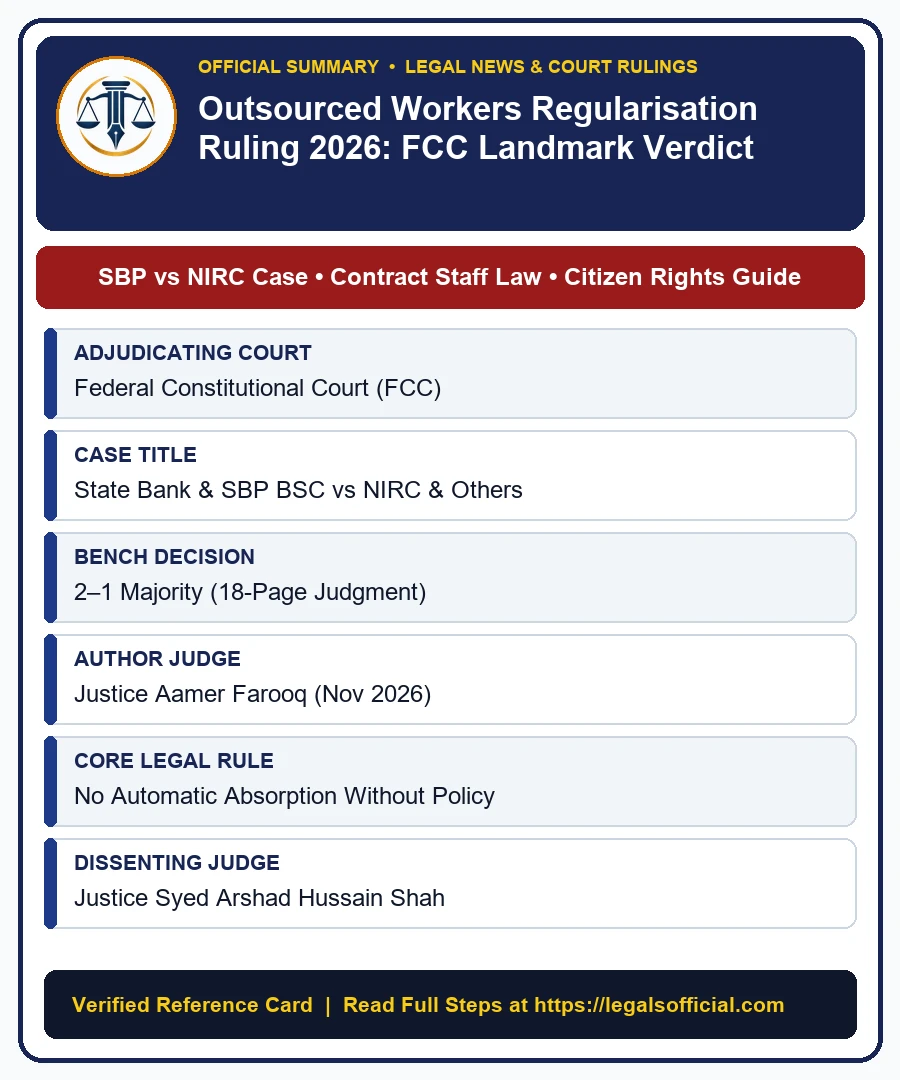
First, Pakistan’s newly empowered superior judiciary delivered a landmark Outsourced Workers Regularisation Ruling that reshapes employment law across public bodies, banks, and corporations. Specifically, a three-member bench of the Federal Constitutional Court (FCC) issued an eighteen-page 2–1 majority verdict in late November 2026. Therefore, HR departments, contract employees, and labor lawyers must understand how third-party hiring contracts now stand.
The dispute originated in State Bank of Pakistan and SBP Banking Services Corporation versus the National Industrial Relations Commission (NIRC). An employee hired in December 2014 through third-party contractor Prime Human Resource Services sought permanent absorption after termination in November 2017. Consequently, the FCC examined whether prolonged service alone converts contractor staff into permanent state employees.
Key Holdings in the Outsourced Workers Regularisation Ruling
Authored by Justice Aamer Farooq and joined by Justice Rozi Khan Barrech, the Outsourced Workers Regularisation Ruling set aside earlier regularisation orders passed by both NIRC and the Sindh High Court. Specifically, the majority held that employees hired through independent third-party contractors possess no automatic right to permanent absorption against the principal organization.
Furthermore, the court clarified that working beyond nine months under the Standing Orders Ordinance, 1968 does not override statutory recruitment rules of public institutions. Unless explicit statutory law, executive policy, or service regulations authorize regularisation, NIRC cannot arbitrarily order permanent appointments. Readers tracking direct central bank hiring can check our State Bank of Pakistan official career posts.
| Aspect / Court | Legal Principle Decided | Practical Impact on Citizens |
|---|---|---|
| FCC Majority (2 Judges) | No automatic regularisation of third-party staff without statutory/policy backing | Binds all High Courts, NIRC & labor forums |
| FCC Dissent (1 Judge) | Articles 3, 4 & 25 protect workers if principal employer exercises direct control | Highlights constitutional test against sham contracts |
| LHC Consumer Ruling (Nov 28) | Self-employed farmer buying fertilizer for livelihood qualifies as ‘Consumer’ | Farmers can sue fake input sellers in Consumer Court |
Constitutional Dissent and November 2026 Citizen Legal Protections
Notably, Justice Syed Arshad Hussain Shah authored a detailed dissenting opinion grounded in Articles 3, 4, and 25 of the Constitution of Pakistan. According to reporting in The Express Tribune, the dissent emphasized that labels like outsourced cannot strip workers of fundamental rights where the principal employer controls daily supervision and wages.
Meanwhile, Pakistani courts also expanded livelihood protections in another major November 28, 2026 judgment. As reported by Dawn, the Lahore High Court ruled under Section 2(c)(i) of the Punjab Consumer Protection Act, 2005 that a self-employed farmer buying fertilizer for livelihood is a protected consumer. Workers seeking statutory welfare grants can also review our WWBS Rs 150,000 worker grant guide.
Practical Takeaways for Contract and Third-Party Employees
- First, verify whether your appointment letter names the principal department or a private human-resource contractor.
- Second, remember that statutory social security (SESSI/PESSI), minimum wage, and EOBI rights still apply to contractor staff.
- Third, apply through advertised merit quotas whenever government departments announce regular BPS or officer vacancies.
- Finally, keep written salary slips, attendance logs, and contract renewals organized for any lawful labor claim.
Why the Outsourced Workers Regularisation Ruling Matters Nationwide
First, under Pakistan’s constitutional framework, decisions of the Federal Constitutional Court bind every High Court, labor court, and tribunal nationwide. Therefore, pending regularisation petitions filed by third-party staff in banks, utilities, and autonomous bodies will now follow this strict statutory test. Employees exploring social security coverage in Sindh can also read our SESSI Sindh updates.
At the same time, contractors remain legally bound to pay notified minimum wages and statutory benefits on time. Understanding this Outsourced Workers Regularisation Ruling helps job seekers distinguish between temporary vendor roles and permanent gazetted posts. Overall, the Outsourced Workers Regularisation Ruling sets the definitive 2026 benchmark for Pakistani labor law.
Frequently Asked Questions (FAQs)
In a 2–1 judgment (SBP vs NIRC), the FCC ruled that third-party contractor workers have no automatic right to permanent regularisation without statutory or policy backing.
Justice Aamer Farooq authored the 18-page majority ruling joined by Justice Rozi Khan Barrech, while Justice Syed Arshad Hussain Shah dissented.
Yes, outsourcing agencies and employers must still comply with minimum wage notifications, EOBI, and provincial social security laws.