Drawing on official data from the Pakistan Economic Survey 2025–26 and the 7th Agricultural Census (2024), agriculture in Pakistan contributed 23.4% to GDP and employed 33.1% of the workforce, driven heavily by strong livestock growth and a record sugarcane harvest despite smaller farm sizes.
Pakistan Agriculture 2026: Facts and Numbers
Pakistan Citizen Services Navigator
Eligibility, documentation & official procedure directoryNotice: This is an independent educational guide. No national identity numbers (CNIC) or fees are collected on this platform. Follow official procedures through designated department counters.
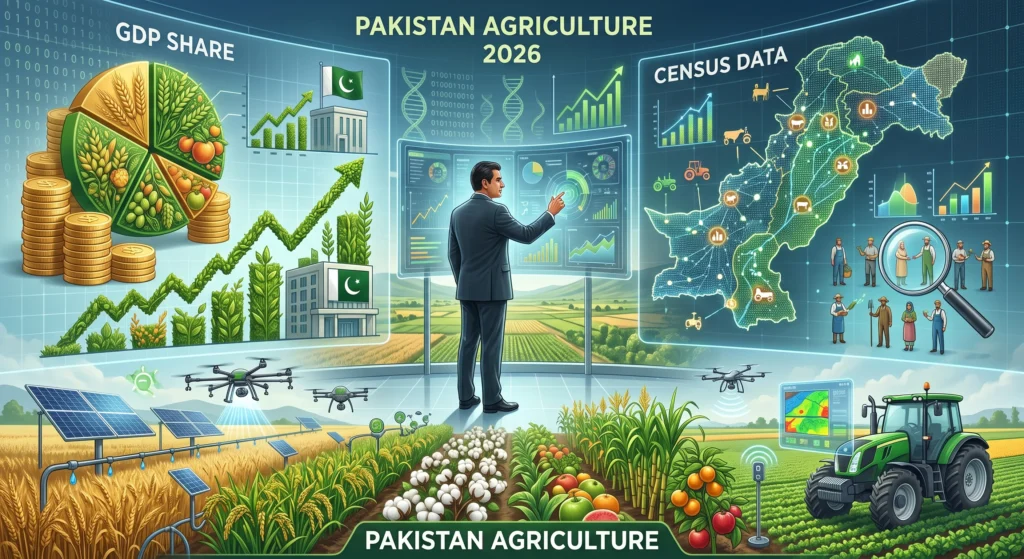
Did you know that farming is the one sector of Pakistan’s economy that never stops being relevant? Pakistan agriculture drives a massive share of national output, feeding a population of over 255 million people, employing roughly a third of the country’s workforce, and generating close to a quarter of national income.
Agriculture contributed 23.4% of national GDP and employed 33.1% of the labour force during the fiscal year, according to the Pakistan Economic Survey 2025–26. This puts Pakistan in an unusual global position compared with other economies. While Pakistan’s agricultural share of GDP sits at roughly 22–24%, India’s sits at about 16%, China’s at 7%, and the United States’ at under 1%. With a GDP per capita of roughly $1,901 in FY26, Pakistan remains firmly agriculture-dependent, which keeps what happens on farms tied closely to poverty levels that stood at 28.9% in the latest survey.
Quick Facts
- Agriculture contributed 23.4% of national GDP and employed 33.1% of the labour force in FY2025–26.
- Total real GDP grew 3.7%, while agriculture grew by 2.89% during the same fiscal year.
- Sugarcane output rose 6.2% to 89.45 million tonnes, and wheat output climbed 4.3% to 29.61 million tonnes.
- The 2024 Agricultural Census recorded a national herd of roughly 251.3 million animals.
- Total farms reached 11.7 million, while the average farm size dropped to 5.1 acres.
- Irrigated land reached 45.9 million acres across the country.
Sector Growth Numbers
Agriculture grew by 2.89% during FY2025–26, which is nearly double the 1.53% recorded the year before. Livestock grew 3.75%, making up a striking 62.4% of total agricultural value addition and 14.6% of national GDP on its own. Crops grew 1.44%, recovering from a 1.01% contraction the previous year. Forestry grew 2.02%, and fisheries grew 1.66% during this period.
Crop Harvest Details
The five major crops—wheat, rice, sugarcane, cotton, and maize—collectively grew just 0.65%, far below their 6.7% target. Sugarcane rose 6.2% to 89.45 million tonnes, supported by expanded cultivation area and a 3.7% yield improvement. Wheat output climbed 4.3% to 29.61 million tonnes, backed by the Interim Wheat Policy 2025–26 and better access to certified seed and fertiliser. Rice production rose 2.8% to just under 10 million tonnes. Meanwhile, cotton slipped 0.5% to 7.05 million bales, and maize fell 2.68% to 8.79 million tonnes due to flood-related yield losses.
Quiet Horticultural Boom
Minor crops and horticulture saw significant gains that contrasted with the major staple crops. Chickpeas surged 50.4%, bananas rose 30.8%, and potatoes climbed 27.6%. Mangoes grew 11.6%, and vegetables overall increased 12.6%. Additionally, total fertiliser nutrient offtake reached 3,795 thousand tonnes during July–March, up 11.4% year-on-year.
Livestock Sector Output
Livestock remains a dependable growth driver, with the 2024 Agricultural Census recording a national herd of roughly 251.3 million animals. Recent Economic Survey figures count buffaloes at 49.1 million, cattle at nearly 62 million, goats at 91.8 million, and sheep at 33.5 million. This output supports rising domestic demand for milk, meat, and dairy, alongside export interest from Gulf markets for halal products.
Farm Census Data
The 7th Agricultural Census (2024) revealed that the number of farms rose from 8.26 million in 2010 to 11.7 million. Cultivated land expanded from 42.6 million acres to 52.8 million acres. Because land grew slower than farm numbers, the average farm size shrank from 6.4 acres to 5.1 acres, with 97% of farmers owning less than 12.5 acres. Punjab holds 5.05 million farms across 31 million acres, Khyber Pakhtunkhwa has 4.17 million farms, Sindh has 1.82 million farms covering 9.19 million acres, and Balochistan registers close to 633,000 larger holdings.
Trade and Export Data
Textile exports reached $16.3 billion, remaining Pakistan’s single largest export category. Food exports faced challenges, recording a combined decline of $1.5 billion, with rice exports falling $1.1 billion and sugar exports dropping $403 million due to stronger domestic demand and policy shifts.
Frequently Asked Questions
What percentage of Pakistan’s GDP comes from agriculture in 2026?
Agriculture contributed 23.4% of Pakistan’s national GDP in FY2025–26, according to the Pakistan Economic Survey.
How many people does agriculture employ in Pakistan?
The sector employs about 33.1% of Pakistan’s total labour force, making it the country’s single largest source of employment.
Which crop performed best in Pakistan’s FY2025–26 season?
Sugarcane was the standout performer, growing 6.2% to a record 89.45 million tonnes, ahead of wheat’s 4.3% growth to 29.61 million tonnes.
How many farms does Pakistan have, and how big is the average farm?
The 7th Agricultural Census (2024) recorded 11.7 million farms nationwide, with an average farm size of just 5.1 acres.
How does Pakistan’s agricultural GDP share compare to other countries?
At roughly 22–24% of GDP, Pakistan’s agricultural dependence is higher than India’s at 16%, China’s at 7%, and the United States’ at under 1%.
This article is for informational purposes and reflects details available as of the Pakistan Economic Survey 2025–26 and the 7th Agricultural Census (2024); always confirm with the official source.